New York
Around the World in Eighty DaysNew York is the decisive hinge between the railway crossing of the United States and the final Atlantic passage in Phileas Fogg’s planned circuit. In the itinerary it is a timed connection, not a destination: the journey assigns seven days to the rail route from San Francisco and nine days to the onward passage to London. When Fogg finally reaches the city, the train has carried him across the continent, but the Atlantic departure he needs has already slipped away.
A Timed Junction in the Route
The itinerary gives New York a precise function in the larger schedule. The rail journey from San Francisco is allotted seven days; the combined steamer-and-rail journey onward to London is allotted nine. Together these legs form part of the eighty-day total, making the city a hinge on which the wager’s remaining timetable turns. New York matters because movement must change systems there: the west-to-east rail passage has to give way to an ocean crossing, and the interval between the two is consequential.
The city’s role becomes concrete in the account of the approach from Chicago. Nine hundred miles still separate the two cities, yet Fogg changes trains immediately and boards the Pittsburgh, Fort Wayne, and Chicago Railway. Its locomotive rushes through Indiana, Ohio, Pennsylvania, and New Jersey before the Hudson comes into view. The route is presented as a rapid succession of states and towns, with the train’s speed measured less by sightseeing than by the distance still to be overcome. New York is the eastern terminus of that long overland movement and the threshold of the next one.
Arrival at the Hudson
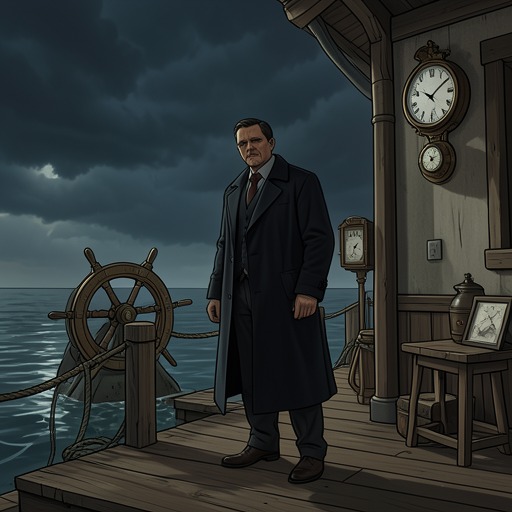
The train stops at a quarter past eleven on the evening of December 11, at a station on the Hudson’s right bank, directly before the Cunard pier. That landing point places rail and maritime travel almost face to face: the train has crossed the country, and the pier offers the apparent continuation of the journey. But the China steamship has left three-quarters of an hour earlier. The proximity of station and pier sharpens the reversal. Fogg has reached the right city and the right waterfront, but not in time for the connection on which his plan depended.
The missed departure is not a minor delay that can be absorbed into the original schedule. On December 12, the remaining interval—from seven in the morning that day until a quarter before nine in the evening on December 21—is nine days, thirteen hours, and forty-five minutes. Had Fogg sailed on the China steamship, he would have reached Liverpool and then London within the agreed period. The calculation makes the loss legible: New York’s significance lies not only in where it is, but in the exact time at which the Atlantic passage becomes unavailable.
The Harbor and the Shrinking Margin
After consulting Bradshaw’s schedule of transatlantic departures, Fogg learns that the other listed services cannot replace the missed ship in time. The Pereire does not leave until December 14. The Hamburg steamers do not go directly to Liverpool or London; their route through Havre, followed by the additional journey to Southampton, would defeat his remaining effort. The Inman steamer is due to depart the next day, but cannot cross the Atlantic quickly enough to save the wager. New York offers several routes across the ocean, yet their timetables and destinations make them unusable for this particular deadline.
On December 12, Fogg leaves the hotel alone and searches the Hudson’s banks for a vessel about to depart. The harbor is described as one from which ships sail for destinations around the globe on nearly every day, but availability is not the same as usefulness: most of the vessels preparing to leave with the morning tide are sailing ships, which cannot serve his purpose. Near the Battery, he spots a screw-propelled trading vessel whose smoking funnel indicates that it is preparing to depart. The scene narrows the city’s expansive maritime traffic to a single practical question: can any vessel leave soon enough and carry him in the necessary direction?
Narrative Significance
New York is rendered through connections, schedules, and points of departure rather than through a tour of its landmarks. The railway station, the Hudson, the Cunard pier, Bradshaw’s listings, and the harbor’s waiting ships form a working geography. Each place matters because it enables or limits onward movement. The narrative’s exact times—the arrival at 11:15 p.m., the missed ship by forty-five minutes, and the remaining nine days, thirteen hours, and forty-five minutes—turn the city into a measure of how little room remains for error.
That precision also establishes a contrast between physical arrival and practical progress. Fogg has crossed the continent and reached the water’s edge, but the planned connection is gone; the city does not complete his journey so much as expose the fragility of the timetable. His response is to search again, first among scheduled services and then among vessels in the harbor. New York therefore marks both the failure of the original transfer and the beginning of a new attempt to keep the wager alive.